
The Career Storytelling Skill Most Professionals Never Learn
Apr 01, 2026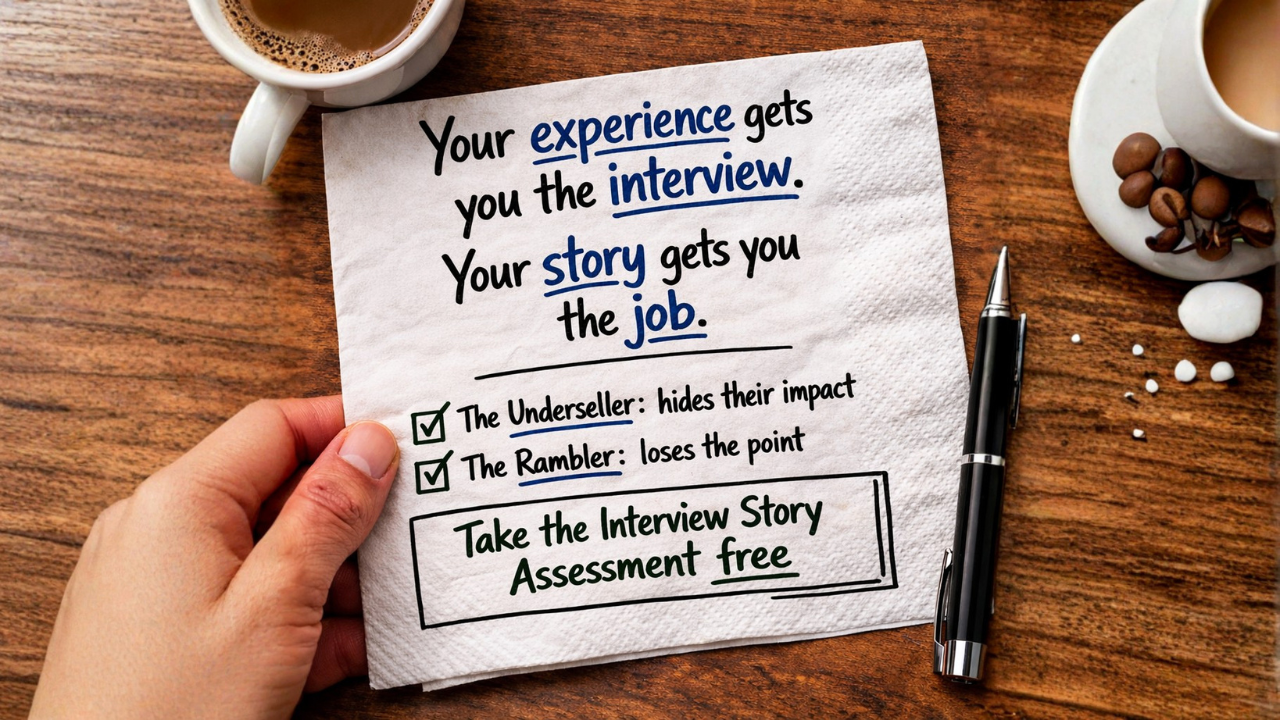
The results are in.
After running the Interview Story Assessment in private beta and now publicly, one very clear pattern is emerging.
And first of all, thank you to everyone who’s taken part so far.
Because the insights have been incredibly revealing.
Here’s the biggest takeaway:
Most people do not struggle in interviews because they lack experience.
They struggle because they do not know how to translate that experience clearly under pressure.
That is the difference.
And one interview archetype is appearing more than any other.
The Underseller: The Most Common Interview Mistake
The most common pattern we’re seeing is something called:
The Underseller
These are people who have achieved far more than they realise…
…but communicate it in a way that massively downplays their impact.
A common example we keep seeing in CVs and interview responses looks something like this:
“Supported the launch of a new internal system.”
Sounds perfectly reasonable.
But when we unpack the actual story behind it, the reality is often much bigger:
- They identified a key inefficiency
- Proposed a new solution
- Worked cross-functionally across teams
- Helped implement the rollout
- Reduced processing time by over 30%
Same experience.
Completely different story.
That’s the gap most professionals never learn to close.
Why Most Interview Answers Get Forgotten
Interviews are not just about experience.
They are about interpretation.
Two people can have almost identical backgrounds…
…but the person who communicates their story more clearly will almost always appear more capable.
Not because they are better.
Because they know how to frame their thinking, decisions, and impact.
That is what interviewers remember.
Most candidates focus too heavily on:
- tasks
- responsibilities
- job descriptions
Instead of:
- outcomes
- reasoning
- problem-solving
- ownership
- decision-making
And that changes how they are perceived instantly.
The Second Most Common Interview Archetype
The second biggest pattern appearing in the assessments is:
The Rambler
These are people with strong experience…
…but no clear structure behind how they communicate it.
So what happens?
Their answers become:
- too long
- unclear
- unfocused
- difficult to follow
They often know the answer internally.
But under pressure, the communication loses clarity.
And once clarity disappears, confidence usually follows.
The frustrating part?
Neither The Underseller nor The Rambler lacks ability.
They simply lack:
- structure
- translation
- storytelling
- positioning
And once that gets fixed, everything changes.
What Great Interviewers Are Actually Looking For
This isn’t just theory either.
I was recently listening to David Senra on the Founders Podcast speaking with Tobias Lütke, Founder and CEO of Shopify.
One part stood out immediately.
When hiring, they are not looking for perfectly rehearsed answers.
They are looking for:
- spikiness
- difference
- individuality
- and most importantly, someone’s story
Because the story reveals how somebody thinks.
Not just what they’ve done.
That distinction matters massively.
Anyone can memorise interview techniques.
But stories reveal:
- judgement
- self-awareness
- leadership
- initiative
- resilience
- communication
That is what makes people memorable.
Why Storytelling Is Becoming the Most Important Interview Skill
The job market is becoming increasingly competitive.
Which means technical ability alone is no longer enough.
The professionals who stand out are the ones who can:
- communicate clearly
- structure experiences effectively
- explain impact confidently
- show how they think
That is why storytelling is becoming one of the most important career skills in modern hiring.
Because interviews are no longer just assessments of experience.
They are assessments of interpretation.
The Goal Is Not to Sound Perfect
This is exactly why I built the Interview Story Assessment.
Not to help people sound polished or robotic.
But to help them:
- identify their interview communication patterns
- understand where they lose clarity
- turn experience into structured stories
- communicate impact more effectively
Because most people already have stronger stories than they realise.
They just have not learned how to tell them yet.
The Difference Between Being Qualified and Being Remembered
The harsh reality is this:
Being qualified does not guarantee being remembered.
And in interviews, memorability matters.
The candidates who stand out are rarely the ones with the perfect CV.
They are the ones who:
- communicate clearly
- structure answers effectively
- show self-awareness
- demonstrate impact through stories
That is what hiring managers remember long after the interview ends.
Try the Interview Story Assessment
If you’re curious where you fall, you can try the assessment below.
You’ll only need to upload your CV (PDF) to receive personalised results and insights into how your interview communication style may be helping or hurting your opportunities.
Take the Interview Story Assessment here:
Take care.
Marc Maley
Founder, My Brand Academy